Home
- Category: Front Page
- Published: 09 March 2017
- Written by Administrator
- Hits: 105305
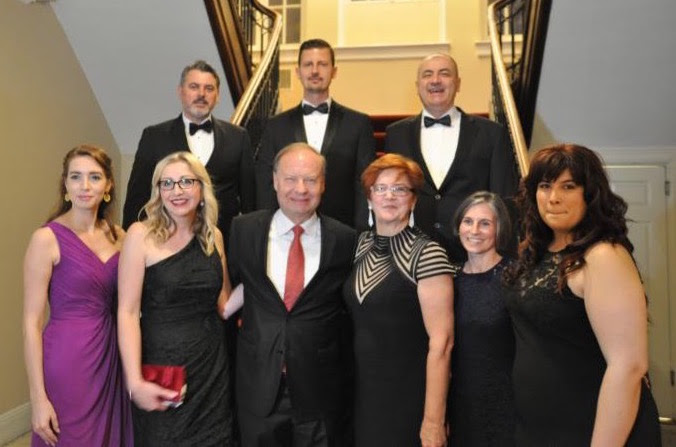
ACBH Executive Director Ajla Delkic (front row, second from the left), TCA President G. Lincoln McCurdy (front row, third from left), and ACBH President Mirzeta Hadzikadic (front row, third from right) with ACBH Board Members at the ACBH 10th Anniversary Gala
TCA received the Advisory Council for Bosnia and Herzegovina’s (ACBH) Friendship Award at its 10th Anniversary Gala on February 25, 2017. The ACBH Gala also celebrated the 25th anniversary of the U.S. recognition of Bosnia and Herzegovina’s (BiH) independence. Also honored at the event for their support of BiH were former Vice President Joseph R. Biden, Jr., who also served as the Gala’s keynote speaker, and former Senator Robert J. Dole.
- Category: Fundraisers
- Published: 25 September 2014
- Written by Administrator
- Hits: 106876

TurkishPAC successfully raised $4000 for reelection of Judge Jay Karahan, highest elected Turkish-American official in the US.
TurkishPAC is organizing a reception to present Judge Karahan's check on October 7th, from 18:00 to 19:00 at the Harvest Organic Grille located at 11681 Westheimer Road, Houston, TX 77077.
Supporters of TurkishPAC and Judge Karahan are invited to the event.
- Category: Fundraisers
- Published: 17 January 2013
- Written by Administrator
- Hits: 29599

"By February 1, 1990, 706 people had applied for medical assistance to medical facilities of Baku. The court medical bureau [sudebno-meditsinskoye byuro] had accepted 84 persons. 73 of them with gunshot wounds (16 in their backs), smashed by APCs 8, bayoneted wounds 2. By February 9, 1990, 170 people, including 6 Russians, 7 Jews, Tatars and Lezgins, had died. Among the dead are six women and 9 children and teenagers. 370 people were wounded. 321 people disappeared." Source: "Black January: Baku 1990, Documents and Materials", AzerNeshr, Baku, 1990, p. 287, with a reference to the Ministry of Health of Azerbaijan SSR.
- Category: General Announcements
- Published: 29 April 2015
- Written by Administrator
- Hits: 27373
Council of Turkish Canadians organized a press conference at the Canadian Parliament on February 26, 2015.
In the video below, Professor Justin A. McCarthy, historian and demographer from University of Louisville, Kentucky and Mr. Bruce Fein, specializing in constitutional law, international law and civil liberties comment on alleged Armenian genocide:
- Category: General Announcements
- Published: 31 October 2012
- Written by Administrator
- Hits: 24605
Several of our members asked us for our recommendations for the November 6 Election. TurkishPAC’s articles of incorporation states that “The Corporation shall not concern itself with the political issues that are inherent to the internal and/or international political operations of the USA or Turkish Governments, otherwise not related to the defense of the Turkish Heritage”. We must therefore base our recommendations only to issues that are related to the defense of the Turkish Heritage.
Based on the above, we recommend that you consider voting for the politicians who are members of the Congressional Turkish Caucus and supported by TurkishPAC. Names and districts of the Turkish Congressional Caucus members are provided below:
- Category: General Announcements
- Published: 08 June 2011
- Written by Administrator
- Hits: 23128
Turkish Coalition of America (TCA) is accepting applications for its 2011 TCAdvance Scholarship Program through Friday, June 17, 2011.
The TCAdvance Scholarship Program was established in 2007 to support American students of Turkish and Turkic heritage who pursue a career in public and international affairs, law and communications. The scholarships are awarded on the basis of academic achievement, civic engagement, particularly active participation in Turkish American community affairs, as well as individual leadership qualities. Since the program's inception in 2007, 48 Turkish American students have been awarded the TCAdvance Scholarship.
- Category: General Announcements
- Published: 04 March 2011
- Written by Administrator
- Hits: 23760

TurkishPAC received a letter from the USA Congressional District 7 Representative Honorable John Culberson on February 24, 2011, which states that he fully supports our opposition to the Congressional Armenian Genocide Resolutions and declares that he plans to vote against such resolutions if they come to the house floor. Honorable Culberson wrote that
"[b]etween
1915 and 1923, brutal fighting took place between Armenian and Ottoman
Turks over the future of Anatolia. While Armenian authorities allege
that up to 1.5 million Armenians were killed and another 500,000 were
forcibly removed in ethnic cleansing, this view is not universally
shared by scholars. Nearly a hundred years have passed since these
alleged crimes took place, yet they still create significant
controversy. Since this is a divisive historical question, experts
should debate the merits of the genocide designation, not members of the
United States House of Representatives. Furthermore, since Turkey is a
close friend of the United States and an important ally in the Global
War on Terror, there is no reason to unnecessarily provoke the emotions
of the Turkish Public.
- Category: General Announcements
- Published: 12 January 2011
- Written by Administrator
- Hits: 23330
The Turkish Coalition of America (TCA) is pleased to announce that it is now accepting applications for its 2011 Washington Summer Internship Program. Since its inception in 2007, 56 Turkish Americans have been placed in internships with prestigious Congressional offices and non-profit organizations. This program provides an opportunity for Turkish American students to live and work in Washington D.C., learn about the American political process, and explore career opportunities in public affairs.


